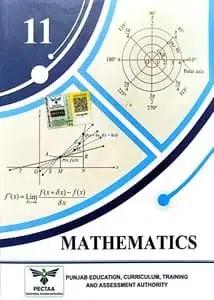
Punjab Board Class 11 Mathematics New Book PDF Download (PCTB / PECTAA) 2026-2027
The Punjab Board Class 11 Mathematics textbook, published by the Punjab Education, Curriculum, Training and Assessment Authority (PECTAA / PCTB), is the official curriculum resource for Intermediate Part 1 (HSSC Part 1 / 1st Year FSc Pre-Engineering & ICS) students for the 2026-2027 academic session. This revised new syllabus book provides thorough coverage of advanced mathematical foundations across 14 chapters, including complex numbers, functions and graphs, quadratic theory, matrices, partial fractions, sequences and series, permutations and combinations, binomial theorem, polynomials, trigonometry, limits, differentiation, and 3D vectors. Students and teachers across all Punjab educational boards can view the complete textbook online or download the free PDF on this page for coursework and board exam preparation.
Overview
What Is the Punjab Board Class 11 Mathematics New Book About?
The Punjab Board Class 11 Mathematics textbook - widely recognized as the PTB Mathematics book, PCTB Mathematics book, or PECTAA Mathematics textbook - is the official, government-approved curriculum text prescribed for students at the Intermediate Part 1 level (1st Year / HSSC Part 1 / FSc Pre-Engineering & ICS) across all higher secondary colleges affiliated with Punjab educational boards. Published by the Punjab Education, Curriculum, Training and Assessment Authority (PECTAA) (formerly Punjab Curriculum and Textbook Board, PCTB / PTB), it establishes the standard academic benchmark for advanced college mathematics in Punjab, Pakistan.
This is the new revised edition for Class 11 Mathematics aligned with the latest PECTAA curriculum for the 2026-2027 academic session. The modern curriculum transitions students from secondary school algebra and geometry into higher-level analytical mathematics, rigorous proofs, computational techniques, calculus fundamentals, and multi-dimensional geometry. It builds a robust conceptual and computational foundation essential for Class 12 (HSSC Part 2) Mathematics, university undergraduate degrees in Engineering, Computer Science, Data Science, and Physics, as well as competitive engineering entrance tests like ECAT, NUST (NET), FAST, and GIKI entry tests.
The textbook is systematically arranged into 14 detailed chapters. It begins with algebraic and numerical foundations in Complex Numbers (Argand diagrams, roots of unity, polar form, AC circuits), Functions and Graphs (domain, range, injective/surjective/bijective mappings, root graphs, financial growth/decay), Theory of Quadratic Functions (max/min optimization, absolute value equations/inequalities), Matrices and Determinants (echelon forms, Cramer's rule, Gaussian elimination, reflection matrices), and Partial Fractions. It proceeds into discrete mathematics with Sequences and Series (AP, GP, HP, AGP, financial arithmetic/geometric series), Permutations and Combinations (circular arrangements, cryptography, probability odds), Mathematical Inductions and Binomial Theorem (extended induction, fractional indices, Pascal's triangle, approximations), and Division of Polynomials (remainder, factor theorem, synthetic division).
The curriculum then advances into analytical trigonometry and foundational calculus with Trigonometric Identities (allied angles, double/half/triple angles, product-to-sum formulas), Trigonometric Functions and their Graphs (periods, sinusoidal wave modeling, Ferris wheel applications), Limit and Continuity (Sandwich theorem, infinite limits, one-sided continuity, radioactive decay & finance applications), Differentiation (first principles, power, product, quotient rules, rates of change, structural stress), and Vectors in Space (3D coordinate systems, dot product, cross product, scalar triple product, volume of parallelepiped, coplanarity, work done, and moment of force).
The 2026-2027 revised edition follows the Student Learning Outcomes (SLO) assessment framework, prioritizing conceptual understanding, analytical proofs, and real-world modeling over mechanical calculation. Intermediate students and teachers are strongly advised to use this official edition for optimal board exam preparation.
Who Should Use This Book?
- FSc Pre-Engineering & ICS Students: Class 11 / HSSC Part 1 students enrolled under BISE Lahore, BISE Rawalpindi, BISE Faisalabad, BISE Multan, BISE Gujranwala, BISE Sahiwal, BISE Sargodha, BISE Bahawalpur, and BISE DG Khan. This textbook is the core source for all board theory papers and objective questions.
- Mathematics Lecturers & Professors: College educators can utilize this official textbook as the benchmark for syllabus pacing, conceptual demonstrations, step-by-step mathematical problem solving, and designing institutional assessments aligned with PECTAA SLO standards.
- Parents: Parents supporting intermediate students can consult this textbook to review the academic syllabus expectations and track their child's progress in 1st Year Mathematics.
- Board Exam & Entry Test Candidates: Students preparing for annual board exams and pre-engineering university entry tests (ECAT, NET, FAST) will find every exercise, theorem, and worked example directly aligned with the examination benchmark.
- Self-Study Learners: Students studying independently can view the textbook online or download the full PDF to master advanced algebra, trigonometry, vectors, and calculus at their own pace.
How Does This New Book Help in Punjab Board Exams?
Intermediate Mathematics requires rigorous problem-solving accuracy, conceptual clarity, and mastery of algebraic and trigonometric manipulations. This PECTAA-authorized textbook is designed to help students excel in every section of the Punjab Board examination paper:
- Theoretical Rigor & Mathematical Proofs: Complete derivations for fundamental laws of trigonometry, binomial theorem expansions, differentiation rules, and vector cross/dot products prepare students for long-form theoretical questions.
- Extensive Exercise Problem Sets: Step-by-step worked examples and extensive exercise sets across all 14 chapters give students the exact problem types tested in board subjective sections.
- SLO-Based Conceptual Depth: Formatted according to Student Learning Outcomes, enabling students to solve unfamiliar, application-based, and analytical mathematical problems confidently.
- Real-World Mathematical Modeling: Practical applications integrated throughout - from AC electrical circuits in complex numbers to financial compound interest in sequences and harmonic motion in trigonometry - develop practical mathematical intuition.
- Syllabus Accuracy: As the official PECTAA/PCTB 2026-2027 edition, it ensures students study the exact curriculum without relying on outdated editions or unapproved notes.
List of Chapters - Punjab Board Class 11 Mathematics
- Complex Numbers
- Functions and Graphs
- Theory of Quadratic Functions
- Matrices and Determinants
- Partial Fractions
- Sequences and Series
- Permutations and Combinations
- Mathematical Inductions and Binomial Theorem
- Division of Polynomials
- Trigonometric Identities
- Trigonometric Functions and their Graphs
- Limit and Continuity
- Differentiation
- Vectors in Space
How to Use This Book
Students and teachers can utilize this page in two simple ways:
- View Online: Read the complete Class 11 Mathematics new textbook directly within your web browser with clear formatting and fast page navigation.
- Download PDF: Save the complete official textbook as a high-quality PDF on your smartphone, tablet, laptop, or desktop computer for offline study anytime, anywhere.
Related Resources
Download Book PDF
Download Book in PDF Format for offline study, revision and exam prepartion