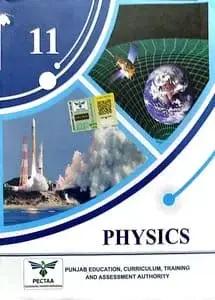
Punjab Board Class 11 Physics New Book PDF Download (PCTB / PECTAA) 2026-2027
The Punjab Board Class 11 Physics textbook, published by the Punjab Education, Curriculum, Training and Assessment Authority (PECTAA / PCTB), is the official curriculum resource for Intermediate Part 1 (HSSC Part 1 / 1st Year FSc Pre-Engineering, Pre-Medical & ICS) students for the 2026-2027 academic session. This revised new syllabus book provides thorough coverage of classical and modern physical principles across 12 chapters, including measurements, mechanics, rotational motion, work and energy, fluid dynamics, thermodynamics, wave mechanics, physical optics, gravitational waves, electrostatics, electromagnetism, special relativity, and nuclear physics. Students and teachers across all Punjab educational boards can view the complete textbook online or download the free PDF on this page for coursework and board exam preparation.
Overview
What Is the Punjab Board Class 11 Physics New Book About?
The Punjab Board Class 11 Physics textbook - widely recognized as the PTB Physics book, PCTB Physics book, or PECTAA Physics textbook - is the official, government-approved curriculum text prescribed for students at the Intermediate Part 1 level (1st Year / HSSC Part 1 / FSc Pre-Medical, Pre-Engineering, and ICS) across all higher secondary colleges affiliated with Punjab educational boards. Published by the Punjab Education, Curriculum, Training and Assessment Authority (PECTAA) (formerly Punjab Curriculum and Textbook Board, PCTB / PTB), it establishes the standard academic benchmark for college-level physics in Punjab, Pakistan.
This is the new revised edition for Class 11 Physics aligned with the latest PECTAA curriculum for the 2026-2027 academic session. The modern curriculum transitions students from secondary school general science into rigorous analytical physics, mathematical formulations, vector analysis, experimental instrumentation, and contemporary scientific frontiers. It builds a robust conceptual and computational foundation essential for Class 12 (HSSC Part 2) Physics, undergraduate degrees in Engineering, Computer Science, and Medical Sciences, as well as competitive entrance tests like MDCAT, ECAT, NUST (NET), FAST, and GIKI entry tests.
The textbook is systematically arranged into 12 detailed chapters. It begins with scientific precision in Measurements (SI base & derived units, scientific notation, uncertainty in digital instruments, significant figures, precision vs accuracy, dimensional analysis & homogeneity) and advances through core mechanics in Force and Motion (vectors & rectangular components, dot/cross products, graphical equations of motion, projectile trajectories, momentum, impulse, elastic/inelastic collisions in 1D & 2D, rocket propulsion), Circular and Rotational Motion (angular kinematics, centripetal dynamics, orbital satellites, weightlessness, artificial gravity, moment of inertia, angular momentum & gyroscopes), and Work, Energy and Power (variable forces, conservative fields, absolute potential energy, escape velocity, work-energy theorem).
The curriculum further expands into continuum and thermal physics in Solids and Fluid Dynamics (mechanical properties, stress-strain, Young's modulus, strain energy, Archimedes' principle, streamline vs turbulent flow, continuity equation, Bernoulli's applications, Stokes' law & terminal velocity) and Heat and Thermodynamics (kinetic theory of gases, real vs ideal gas laws, first & second laws of thermodynamics, isothermal/adiabatic processes, Carnot engine & theorem, refrigerators, entropy). Wave phenomena and modern discoveries are explored through Waves and Vibrations (superposition, interference, stationary waves in strings & organ pipes, ripple tank diffraction, beats, Doppler effect), Physical Optics and Gravitational Waves (polarization, Brewster's & Malus's laws, GW predictions, binary inspiral, interferometers & Virgo detection), Electrostatics and Current Electricity (Coulomb's law, Gauss's law, electric potential gradient, Ohm's law, Kirchhoff's rules, Wheatstone bridge, potentiometer, thermistors, LDRs), and Electromagnetism (magnetic force, flux linkage, velocity selector, Faraday's & Lenz's laws, ferrofluids, seismometers).
The final chapters introduce revolutionary modern physics with Special Theory of Relativity (inertial frames, simultaneity, time dilation, length contraction, mass variation, mass-energy equivalence $E=mc^2$, spacetime continuum) and Nuclear and Particle Physics (nuclear properties, fundamental forces, matter-antimatter annihilation, radioactive decay, hadrons, leptons, quarks, Higgs boson, quantum field theory, string theory, and the Standard Model). The 2026-2027 revised edition follows the Student Learning Outcomes (SLO) assessment framework, prioritizing conceptual understanding, mathematical problem-solving, and experimental awareness over rote memorization.
Who Should Use This Book?
- FSc Pre-Medical, Pre-Engineering & ICS Students: Class 11 / HSSC Part 1 students enrolled under BISE Lahore, BISE Rawalpindi, BISE Faisalabad, BISE Multan, BISE Gujranwala, BISE Sahiwal, BISE Sargodha, BISE Bahawalpur, and BISE DG Khan. This textbook is the primary source for all board theory questions, numerical problems, and objective MCQs.
- Physics Lecturers & Educators: College professors and instructors can utilize this official textbook as the benchmark for syllabus pacing, conceptual demonstrations, derivation derivations, numerical problem sets, and designing institutional assessments aligned with PECTAA SLO standards.
- Parents: Parents supporting intermediate students can consult this textbook to review the academic curriculum expectations and track their child's progress in 1st Year Physics.
- Board Exam & Entry Test Candidates: Students preparing for annual board exams, MDCAT, and engineering university entry tests (ECAT, NET, FAST, GIKI) will find every concept, derivation, and numerical example directly aligned with examination benchmarks.
- Self-Study Learners: Students studying independently can view the textbook online or download the full PDF to master mechanics, thermodynamics, electromagnetism, and modern physics at their own pace.
How Does This New Book Help in Punjab Board Exams?
Intermediate Physics requires a solid balance of theoretical clarity, rigorous mathematical derivations, and precision in numerical problem solving. This PECTAA-authorized textbook is crafted to help students excel in every section of the Punjab Board examination paper:
- Thorough Theoretical Derivations: Step-by-step mathematical proofs for equations of motion, centripetal acceleration, Bernoulli's equation, Carnot efficiency, Doppler shifts, Gauss's law, and Faraday's law prepare students for board descriptive long questions.
- Extensive Numerical Problem Sets: Solved examples and end-of-chapter numerical exercises across all 12 chapters equip students with the computational skills required for board examination numericals.
- SLO-Based Conceptual Rigor: Aligned with Student Learning Outcomes, enabling students to tackle unfamiliar, reasoning-based, and analytical physics questions with ease.
- Modern Scientific Frontiers: Inclusion of cutting-edge topics such as gravitational waves, Virgo interferometry, special relativity, quarks, and the Higgs boson develops modern scientific awareness.
- Syllabus Accuracy: As the official PECTAA/PCTB 2026-2027 edition, it ensures students study the authentic, up-to-date curriculum without the risk of outdated prints.
List of Chapters - Punjab Board Class 11 Physics
- Measurements
- Force and Motion
- Circular and Rotational Motion
- Work, Energy and Power
- Solids and Fluid Dynamics
- Heat and Thermodynamics
- Waves and Vibrations
- Physical Optics and Gravitational Waves
- Electrostatics and Current Electricity
- Electromagnetism
- Special Theory of Relativity
- Nuclear and Particle Physics
How to Use This Book
Students and teachers can utilize this page in two simple ways:
- View Online: Read the complete Class 11 Physics new textbook directly within your web browser with clear formatting and fast page navigation.
- Download PDF: Save the complete official textbook as a high-quality PDF on your smartphone, tablet, laptop, or desktop computer for offline study anytime, anywhere.
Related Resources
Download Book PDF
Download Book in PDF Format for offline study, revision and exam prepartion